Euler's Identity e^(iπ) + 1 = 0, computed via exp() and checked against machine epsilon.
GNU Octave · Math & Physics Lab
Euler, Gauss, Nash & Hilbert — an Octave compendium
A catalog of every .m script in this folder: number theory, curvature,
Fourier & Hilbert space, game theory, quantum mechanics, and a few unclassifiable detours
through DNA and water molecules. All scripts target GNU Octave 7+ with no toolboxes.
65 top-level scripts
3 packaged bundles
9 themes
All
Euler's Number
Basel · Zeta · Riemann
Number Theory
Gauss
Curvature & Geometry
Hilbert & Fourier
Game Theory
Physics
Chemistry & Biology
No files match that search.
Euler's Number & Identity
7 filese, e^{iθ}, and the unit circle as a complex exponential.
Approximates e via the compound-interest limit and the factorial series; verifies Euler's formula.
Identical content to euler2.m — e via compound interest and the factorial series.
Verifies Euler's formula numerically: the unit circle traced by e^{iθ}.
3D helix visualization of e^{iθ}, stacking the complex exponential along time.
Derives angle-addition trig identities (cos/sin of α+β) directly from Euler's formula.
The unit circle as an algebraic group: points (cos θ, sin θ) with angle addition as the group law.
Basel Problem, Zeta & Riemann
6 filesFrom ∑1/n² to Euler products to the still-open Riemann Hypothesis.
Partial sums of the Basel series ∑1/n², plotted converging toward π²/6.
Approximates ζ(s) via the Euler product over primes.
Combined demo: Euler's identity on the unit circle, the Basel problem, and the e series.
Basel sum, Euler product, ζ(2), ζ(4), the ζ(−1)=−1/12 regularization, Casimir energy, and π(x)~x/log x.
Riemann Hypothesis overview and numerical exploration of non-trivial zeta zeros.
A more heavily-documented outline script covering the same Riemann Hypothesis ground as rh3.m.
Number Theory & Modular Arithmetic
13 filesTotients, congruences, Gaussian integers, graphs, and cryptography.
Königsberg's bridges as an adjacency matrix; checks for an Eulerian circuit or trail.
Congruence basics: mod arithmetic, a multiplication table mod 7, and a powermod helper.
Identical content to euler5.m — congruence basics and the mod-7 multiplication table.
Congruence warm-up followed by a from-first-principles implementation of Euler's totient function.
Totient by brute-force gcd counting vs. Euler's product formula, side by side.
Visualizes coprimality up to n as a sieve.
φ(n): counts 1≤k≤n with gcd(k,n)=1. Example: phi_euler(12) → 4.
A full worked lab on Euler's totient function φ(n), built out step by step.
Visualizes multiples of a (mod m) as clock arithmetic. Example: modular_clock(7,12,20).
General Eulerian-trail condition check from vertex degrees (the Königsberg bridges, formalized).
Explores ℤ[i]: norm N(a+bi)=a²+b², and the Gaussian-prime test.
Totient, Euler's theorem, modular inverse via extended Euclid, fast modpow, toy RSA, and Diffie–Hellman.
A proof-outline script surveying Fermat's Last Theorem.
Gaussian-integer arithmetic representing a+bi as [a, b] pairs.
Gauss — Statistics, Fitting & Signals
4 filesLeast-squares line fit y = mx + b (Gauss, 1809), with residual plots.
Plots the normal distribution and shades the 68-95-99.7 rule.
Fits a parabola through three observed points — the shape of a projectile, or Ceres' apparent path.
A signal with two hidden tones plus noise; shows the DFT as a matrix of Euler's formula.
Curvature & Geometry
5 filesGaussian curvature K for a paraboloid z = ax²+by² (Theorema Egregium). Example: curvature_demo(1,1).
Gaussian curvature, saddle vs. sphere, string vibration modes, and a note on Calabi–Yau Ricci-flatness.
Space-filling Hilbert curve, [0,1] → [0,1]².
Space-filling curve plus a note linking it to cardinality and Hilbert-space completeness.
Nash–Kuiper embedding: corrugation that preserves length.
Hilbert Space, Fourier & Spectral
6 filesBijections for Hilbert's infinite hotel: n→n+1, n→2n, and Cantor pairing.
L2 Fourier series approximation and Parseval's identity.
Modified Gram–Schmidt: builds an orthonormal basis of a Hilbert space ℝⁿ.
2×2 symmetric eigen-decomposition as ellipse axes, plus the Hilbert matrix's condition-number explosion.
Fourier series synthesis, FFT spectrum, Parseval's identity, and the Gibbs phenomenon.
The catenary as the curve minimizing potential energy, via the Euler–Lagrange equation.
Game Theory (Nash)
5 filesPure and mixed Nash equilibria for a 2×2 bimatrix game.
Plots expected payoffs vs. mixed strategies to visualize best-response curves.
Nash bargaining solution: maximizes (u1−d1)(u2−d2) over a convex polygon of feasible outcomes.
Cournot duopoly: solves for Nash equilibrium quantities.
Nash–Moser: a smoothed, damped Newton's method compared against the plain version where derivatives lose regularity.
Physics — Waves, Circuits & Quantum
9 filesEM plane waves e^{i(kx−ωt)}, the Helmholtz equation, RLC impedance Z=R+i(ωL−1/ωC), and resonance ω₀=1/√LC.
Phasor diagrams: V=IZ, VR+VL+VC, and |Z|, arg(Z).
Matrix mechanics in ten lines: builds X and P for the harmonic oscillator and checks XP−PX ≈ i·I.
Schrödinger's cat as a wavepacket "sometimes in the middle," solved with Crank–Nicolson.
Newton's three-body problem, numerically simulated.
Applies the midpoint method to the three-body problem, linking two related numerical ideas.
Bridges the three-body problem with a Schrödinger-equation treatment.
Solves an ODE y′=f(t,y) with the explicit Euler method. [t,y]=euler_method(f,t0,tf,y0,h).
An earlier variant of the explicit Euler integrator with a different argument order.
Chemistry & Biology
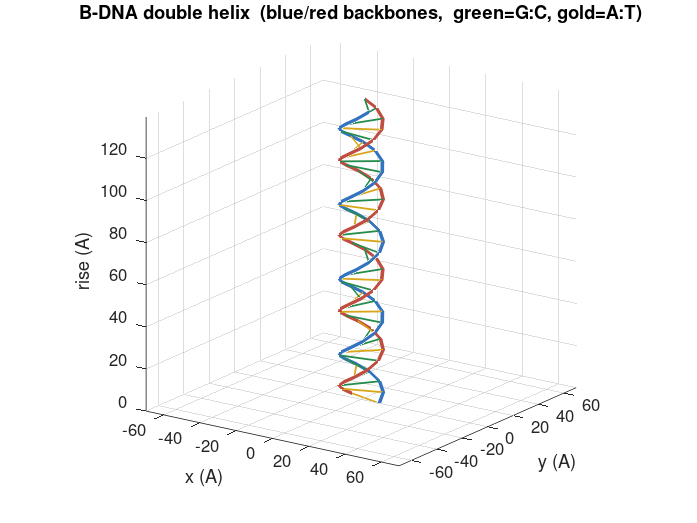
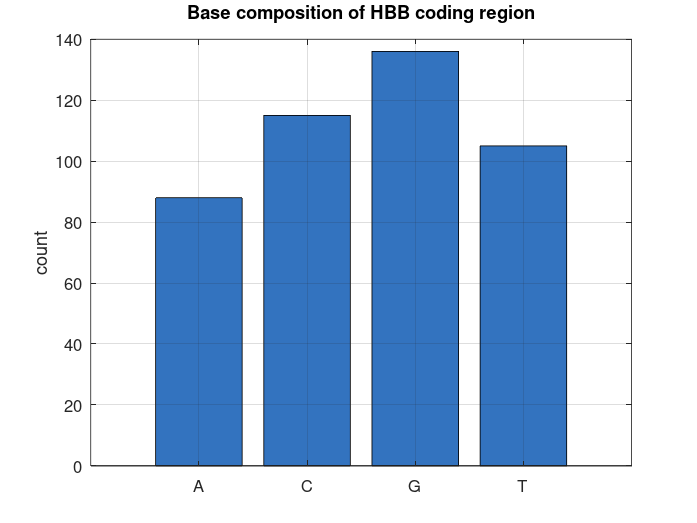
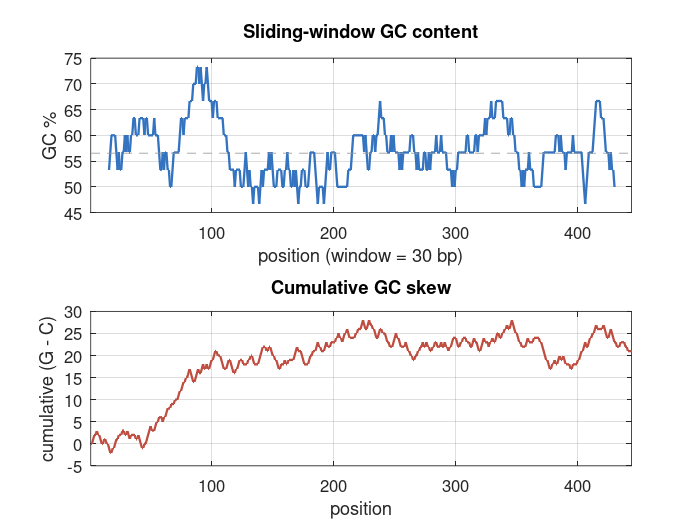
3 filesThe mathematics of DNA — base composition, GC content, and helical geometry.
H₂O molecular geometry.
H₂O as a covalent molecule: 3D geometry, the ~104.5° bond angle, and animated normal modes.
Packaged Bundles
The same scripts, re-grouped into self-contained folders with their own README — meant for standalone distribution alongside an HTML compendium.
Euler_Gauss_Octave_Bundle
11 scripts on totients, Euler's identity, the Basel sum, the Euler-product ζ(s), Königsberg, modular arithmetic, Gaussian integers, and curvature.
View README →Nash_Hilbert_Octave_Bundle
12 scripts split into NASH (equilibria, bargaining, Cournot, embedding) and HILBERT (infinite hotel, Fourier, Gram–Schmidt, spectral theory, space-filling curves, catenaries).
View README →Unified_Octave_Bundle
7 scripts tracing one throughline — Fourier → Maxwell → circuits, Gauss's totient → RSA cryptography, curvature → Calabi–Yau strings, and the Basel sum → ζ-regularization → string theory's D=26.
View README →Notes
Plain-text explainer on the midpoint Riemann sum method, companion to three_body_midpoint_demo.m.